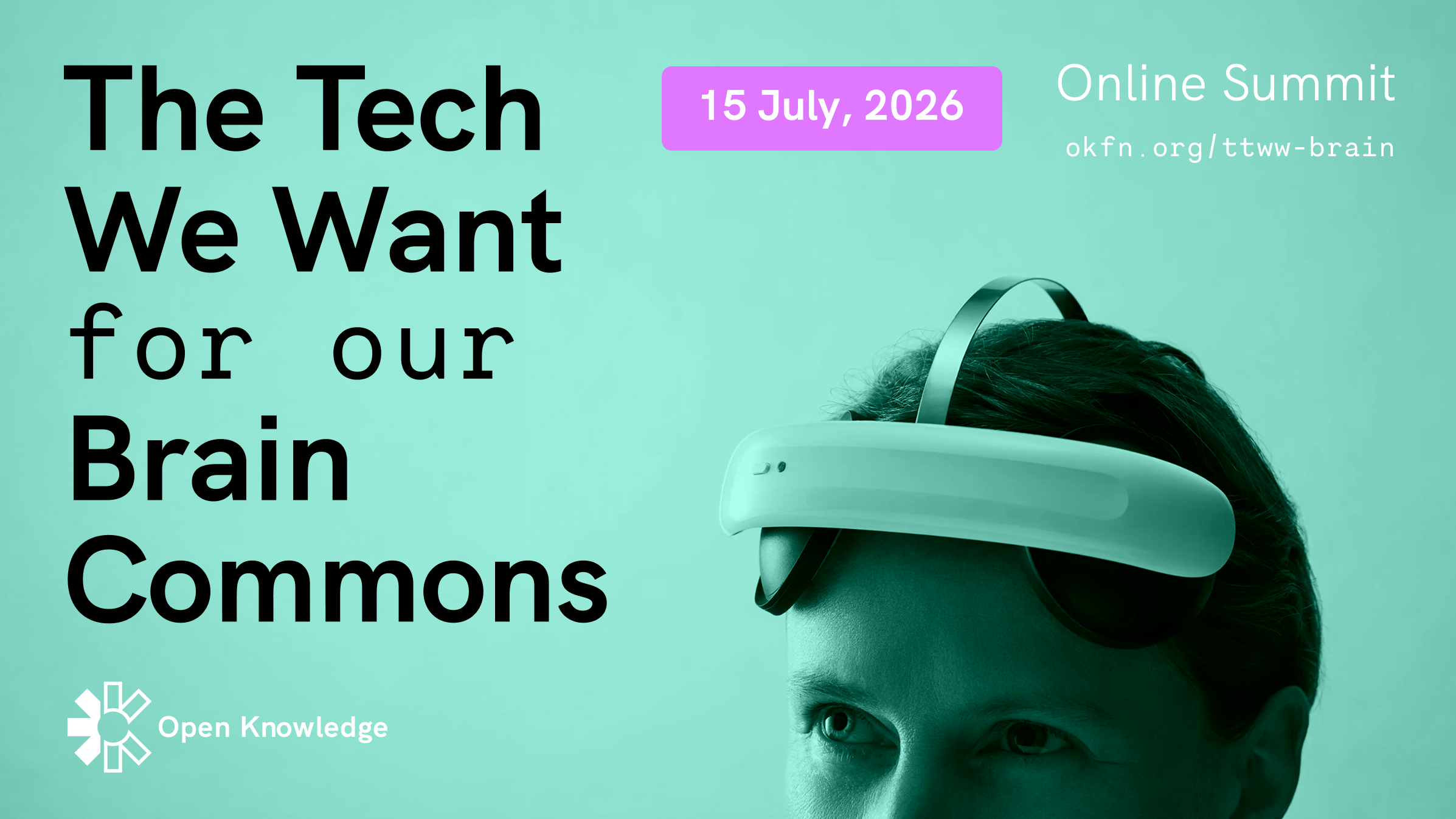
How can we ensure that the emerging brain commons remains open, accountable and governed in the public interest?


Commercial brain-computer interfaces (BCIs) are rapidly moving beyond research laboratories into consumer markets, workplaces, healthcare, education and entertainment. The decisions made today about how these technologies are designed, governed and deployed will influence whether they become open tools that expand human agency or closed infrastructures that concentrate power over our cognitive lives.

Part of The Tech We Want initiative by the Open Knowledge Foundation (OKFN), this event brings together researchers, developers, policymakers, journalists, civil society and industry to explore how openness can help shape a future in which neurotechnology remains transparent, accountable and aligned with democratic values.

Our discussions will examine how openness in hardware, software, data and governance can strengthen existing protections, foster innovation, enable public oversight and preserve individual autonomy.

Join us:

🗓️ Wednesday, 15 July 2026
🕐 14:00 —
19:00 CEST
📍 Online, free of charge


14:00 CEST

Opening Remarks

Introduction to the BCI Open Stack Project by the Open Knowledge Foundation, and why commercial neurotechnology matters now.


14:30 CEST

[Panel] Understanding the BCI Stack: Where Openness Matters

Before discussing governance, there is a need for a common understanding of how commercial BCIs actually function. This session unpacks the complete technology stack, from sensors and firmware through machine learning, cloud services and applications, including emerging AI integrations and identifies where openness or enclosure determines who ultimately controls the technology.

Speakers in alphabetical order:

Christoph Guger – CEO, g.tec
Guger Christoph studied electrical and biomedical engineering at the University of Technology Graz in Austria and Johns Hopkins University in the USA and received his PhD in 1999. In 1999 he started the company g.tec which produces high-quality neurotechnology and real-time brain computer interfaces for the research, medical and consumer market. The company is active in many international research projects about brain-computer interfacing, neuromodulation, stroke rehabilitation, assessment and communication with patients with disorders of consciousness and high-gamma mapping in epilepsy and tumor patients.

Harry Halpin – CEO and Chairman of Scientific Board, Nym Technologies
Prior to founding Nym, a startup building a decentralized mixnet to end mass surveillance, Harry was a research scientist at W3C/MIT and Inria de Paris where he led the standardization of the Web Cryptography API across all browsers and initiated the Web Authentication work that led to passkeys and the federated social web standards like ActivityPub. He has a Ph.D. in Artificial Intelligence from the University of Edinburgh and completed his postdoctoral studies in philosophy under Bernard Stiegler. He teaches cryptocurrency at the American University of Beirut and crypto-anarchist theory at the New Centre for Research and Practice.

Solana Larsen (moderator) – Editor & AI Literacy Lead, Open Knowledge Foundation
Journalist and editor with two decades of experience at the intersection of technology and society. Before OKFN, she worked at Mozilla, where she led the annual Internet Health Report, a compilation of data and stories about the state of the internet, as well as two seasons of Mozilla’s podcast on AI, IRL: Online Life is Real Life. Before that, she served as the managing editor of Global Voices, a community of writers and translators who amplify the voices of grassroots and citizen media worldwide.

Zoe Steine-Hanson – Research Scientist at OpenBCI
Passionate about driving the future of human-computer interaction with brain-computer interfaces, Zoe works at the intersection of machine learning, human subjects research, physiological data analysis, and neurotechnology software. Prior to joining OpenBCI, Zoe completed her PhD at the University of Washington, where her research focused on developing generalized machine learning models to interpret brain data. Zoe also spent six months as an intern at Meta Reality Labs, where she developed machine learning models for Meta's Neural Band.


15:30 CEST

[Panel] Governing the Brain Commons: Openness as Public Infrastructure

As neurotechnology becomes part of everyday life, governance cannot rely solely on privacy discussions or future legislation. This panel explores how openness can support accountability through interoperability, transparency, procurement, competition, scientific scrutiny and public oversight. Speakers will emphasise practical governance mechanisms that can be implemented today using existing institutions and legal frameworks.

Speakers in alphabetical order:

Iness Ben Guirat – Post-doctoral researcher, Université Libre de Bruxelles
Iness is a researcher at the Université Libre de Bruxelles, where her work is funded by the FNRS (Fonds de la Recherche Scientifique). She previously earned her PhD from KU Leuven under the supervision of Prof. Claudia Diaz. Her research interests include privacy-enhancing technologies, peer-to-peer systems, and smart city infrastructures. She is particularly interested in the socio-technical aspects of privacy, a perspective explored in her position paper 'Resistance Technologies: Moving Beyond Alternative Designs'.

Laura Cabrera – Advisory Board Member, IEEE Brain and IEEE TechEthics
Dr. Cabrera is the Dorothy Foehr Huck and J. Lloyd Huck Chair in Neuroethics. She is Professor of Engineering Science and Mechanics, and Philosophy at Penn State University. She received a BEng in Electrical and Communication Engineering from the Instituto Tecnológico de Estudios Superiores de Monterrey (ITESM) in Mexico City, an MA in Applied Ethics from Linköping University in Sweden, and a PhD in Applied Ethics from Charles Sturt University in Australia. Dr. Cabrera's research interests focus on the ethical, societal, and cultural implications of the design, development and use of neurotechnologies and other disruptive technologies, as well as their governance strategies, working at the interface of normative, conceptual and empirical approaches. She is also chair of the P7700 -Recommended Practice for the Responsible Design and Development of Neurotechnologies - Standard Development Group.

Reinhold Scherer – Vice President, BCI Society
Professor of Brain Computer Interfaces (BCIs) and Neural Engineering at the University of Essex and Head of the School of Computer Science and Electronic Engineering. For more than twenty years, Reinhold's work has focused on computational and systems level methods for decoding, modelling, and interacting with neural processes. He has concentrated on nonimplanted Brain-Computer Interfaces, developing algorithms that extract reliable information from electroencephalographic (EEG) and other neurophysiological signals and translate these signals into real time control, communication, and adaptive feedback mechanisms. His academic training spans engineering, computer science, and applied neuroscience.

Renata Ávila (moderator) – CEO, Open Knowledge Foundation
International human rights and technology lawyer and openness advocate. Renata is helping individuals and organisations access and use data to take action on the most pressing social problems, as well as preserving and enhancing human rights through open standards, policy and advocacy. In her previous practice, focused in strategic litigation for access to information and access to justice, she represented high profile human rights advocates, including Nobel Peace Prize Rigoberta Menchu Tum. A former fellow and affiliate of the Stanford Institute of Human-Centred Artificial Intelligence, she is currently associated with the Center for Internet and Society at CNRS, France. She participates on the boards of several organisations, including Open Future, the Center for the Advancement of Infrastructural Imagination and the Just Net Coalition. She co-founded the <A+> Alliance for Inclusive Algorithms and the Progressive International.


16:45 CEST

Break


17:00 CEST

[Keynote] Freedom of Thought in the Age of Neurotechnology

This keynote broadens the conversation beyond technology and governance to consider the societal implications of technologies that increasingly interact with our minds. Rather than discussing legal doctrine, it examines freedom of thought as the foundation of democracy, creativity and human dignity, reflecting on the responsibilities that accompany technologies capable of influencing cognition, attention and behaviour.

Speaker:

Christoph Bublitz – Legal Scholar, University of Hamburg
Bublitz works at the intersection of law, philosophy, and cognitive sciences. One of his main research interests is the legal regulation of the human mind and mind-affecting technologies. As a leading scholar on the human right to freedom of thought, he argues for the revitalisation of this neglected right. Currently, he is the PI of research projects on law and psychedelics as well as virtual reality. He has published extensively in legal and philosophical journals, is an associate editor of Neuroethics and co-editor of the Palgrave Series on Law, Neuroscience and Human Behavior. He has served as an expert adviser to numerous national and international institutions and received several academic awards for his work.


Followed by a conversation with:

Renata Ávila – CEO, Open Knowledge Foundation


18:00 CEST

[Keynote] The Future of Freedom of Thought: Keeping Human Agency Open in the Age of Brain-Computer Interfaces

As neurotechnologies move from laboratories into everyday life, how do we ensure they strengthen rather than erode the human capacity to think freely, make autonomous choices and participate in open societies?

This keynote explores why cognitive freedom is not only an individual concern but a cornerstone of democracy, creativity and social trust. Therefore, openness is not simply a technical characteristic but a democratic commitment to preserving human agency in the next generation of digital infrastructure.

Speaker:

Susie Alegre – International Human Rights Lawyer, and Author
Dr Susie Alegre is a barrister and associate at Garden Court Chambers and a Senior Fellow at CIGI where she leads a research programme on the right to freedom of thought in the 21st Century. She is a pioneer in digital rights, elaborating a new perspective on freedom of thought in the modern era, and has advised civil society, international organisations and governments on the implications of technology for human rights. Her book, 'Freedom to Think' (2022), was a Financial Times and Daily Telegraph book of the year and shortlisted for the Royal Society of Literature Christopher Bland Prize. Her latest book, 'Human Rights, Robot Wrongs: Being Human in the Age of AI' (Atlantic Books 2024) is a seminal work on the latest wave of technological innovation.


Followed by a conversation with:

Burcu Kilic – Principal Researcher, Open Knowledge Foundation
Burcu Kilic is a CIGI senior fellow and a scholar, strategist and expert in trade and technology policy. She also teaches technology policy and international affairs as a professorial lecturer at the Elliott School of International Affairs at George Washington University.


Registration

This is an open online event free of charge. We welcome registrations from everyone who is interested in taking a critical look at current technologies.

For questions and queries regarding the programme or any aspect of registration process, please contact info@okfn.org.


About us

The Tech We Want for Our Brain Commons is organised by:


The Open Knowledge Foundation (OKFN) believes knowledge should be accessible to everyone. That is why we advance open content, data and technology for over 20 years. We build and maintain digital infrastructure and digital public goods that anyone can use, and we encourage truly open collaboration and purposeful innovation, including for AI and other frontier technologies. OKFN is the organisation behind the AI Learning LabsOpen Definition, Open Data Commons, School of Data, and tools like CKAN, Frictionless Data and the Open Data Editor. Our work supports a fair, safe, and sustainable internet for all.


The Tech We Want is a collective conversation about new practical ways to build software that is useful, simple, long-lasting and focused on solving people's real problems.

Since 2023, OKFN has been advocating together with the community of developers working on public-interest technologies for climate-friendly, accessible and sustainable approaches to technology. Understanding the potential ecological and societal impacts of various development decisions is the first step towards another stack with different metrics, community practices and guidelines.

Let's build together a world where all knowledge is accessible to everyone
Let's build together a world where all knowledge is
accessible to everyone
Get in touch

Don't miss a thing

Stay on top of what's happening in the #OpenMovement around the world. (We will never spam you!)